

A digital marketing challenge rarely arrives with a neat solution. A business may be getting plenty of website visitors but very few enquiries, generating leads that never convert, or losing potential customers to competitors. At a Digital marketing training center in Coimbatore, learners can explore how these visible symptoms often point to deeper business and customer-journey problems.
Instead of immediately jumping into SEO, paid advertising, social media or content creation, a skilled digital marketer first asks what is actually causing the gap. They examine customer behaviour, campaign data, search intent, website performance and conversion points to identify where the business is losing opportunities.
The real strategic skill lies in turning that discovery into a focused marketing direction. Once the problem is clearly defined, the marketer can choose the right channels, create relevant actions, set measurable goals and build a strategy that supports an actual business outcome—not simply more digital activity.
A Business Problem Is Usually Bigger Than a Marketing Task
Imagine a training institute receives 500 website visitors every month but only five enquiries. The obvious reaction might be to increase traffic.
The website could be attracting students who are searching for free learning resources rather than paid courses. The course pages might lack clear information. The enquiry form could be too complicated. The call-to-action may not appear at the right point. Or the traffic may be coming from keywords that have high search volume but weak buying intent.
A strategic digital marketer does not immediately launch another campaign. They first define the actual business problem.
A useful starting point is:
Business symptom → Possible cause → Evidence → Marketing opportunity → Strategy
This prevents marketing teams from spending budgets on activities that look busy but fail to solve the original problem.
Turn the Problem Into a Question That Can Be Measured
“Sales are low” is a problem statement, but it is not yet a useful marketing question.
A better question might be:
“Why are website visitors not moving from product pages to enquiries?”
Now the marketer can investigate specific stages.
| BUSINESS ISSUE | STRATEGIC QUESTION |
|---|---|
| Low enquiries | Where are potential leads dropping off? |
| High website traffic | Is the traffic relevant to the offer? |
| Low sales | Is the problem demand, trust or conversion? |
| Expensive leads | Which campaigns produce qualified prospects? |
| Weak organic results | Are content and search intent aligned? |
This transformation makes the problem actionable.
Instead of trying to “do more marketing,” the team can identify the exact part of the customer journey that needs improvement.
Use Data to Find the Story Behind the Numbers
Data does not automatically provide a strategy. It provides clues.
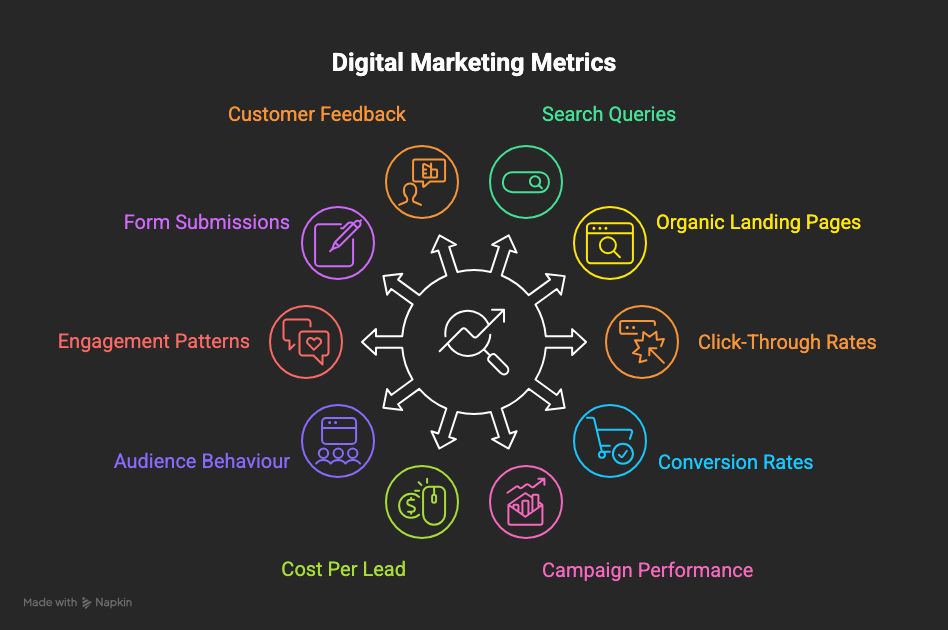
A digital marketer may examine:
- Search queries and keyword intent
- Organic landing pages
- Click-through rates
- Conversion rates
- Campaign performance
- Cost per lead
- Audience behaviour
- Engagement patterns
- Form submissions
- Customer feedback
Suppose an education website receives substantial traffic from the keyword “digital marketing course,” but very few visitors enquire.
The marketer should not simply conclude that SEO is working poorly.
They may discover that visitors are landing on an informational blog instead of a course page. The keyword may have mixed intent. The content may answer questions but provide no compelling next step.
The strategic response could therefore involve search-intent mapping, internal linking, landing-page optimisation and stronger calls to action.
That is a much more useful conclusion than simply saying, “We need more traffic.”
Map the Customer Journey Before Choosing Tactics
Customers rarely move directly from seeing an advertisement to purchasing.
Their journey may look more like:
Search → Content → Website → Comparison → Trust-building → Enquiry → Follow-up → Purchase
Every stage can create friction.
For example, an architecture firm may receive visitors after searching for residential architects. They read a service page, view a project, check reviews and then leave without contacting the company.
The problem may not be visibility. The missing element could be trust.
A strategic marketer might therefore recommend stronger project case studies, process explanations, testimonials, location-specific content and a clearer consultation CTA.
This customer-journey thinking is one of the areas learners can develop through practical work at a Digital marketing training center in Coimbatore, particularly when campaigns are analysed from the customer’s perspective rather than only from platform dashboards.
Match Search Intent With the Right Marketing Response
Search behaviour can reveal what a customer wants at a particular moment.
Someone searching:
“what is digital marketing”
may still be exploring.
Someone searching:
“digital marketing course fees in Coimbatore”
is much closer to evaluating an actual purchase.
A marketer should therefore avoid treating every keyword equally.
| INTENT | LIKELY CUSTOMER NEED | MARKETING RESPONSE |
|---|---|---|
| Informational | Learn something | Guides, blogs, videos |
| Commercial | Compare options | Service pages, comparisons |
| Transactional | Take action | Landing pages, offers |
| Local | Find nearby provider | Local SEO, GBP, location pages |
This approach improves both content relevance and advertising efficiency.
The objective is not simply to rank for more keywords. It is to connect the right search intent with the right business response.
Build a Strategy Around Priorities, Not Everything at Once
A common mistake is creating a huge marketing plan containing SEO, social media, email, Google Ads, influencer campaigns, video, blogs and automation—all at once.
A strong strategy prioritises.
A marketer can classify opportunities using three simple factors:
Impact: How strongly could this affect the business?
Effort: How much time, money and expertise will it require?
Evidence: How confident are we that it addresses the actual problem?
For example, fixing a broken enquiry form may have high impact, low effort and strong evidence.
Creating 50 new social media posts may have uncertain impact.
The first action should usually come before the second.
This prioritisation mindset makes a Digital marketing training center in Coimbatore valuable when learning focuses on solving realistic business situations rather than simply completing individual tool exercises.
Connect SEO, Content and Paid Marketing
Digital channels should not operate as isolated departments.
Suppose paid search data reveals that customers frequently convert after searching for a particular service phrase. That information can influence SEO priorities.
Similarly, an SEO page that consistently attracts qualified visitors can reveal valuable messaging for paid campaigns.
Content can support both.
The relationship can become:
Paid data → Customer insight → Content idea → SEO opportunity → Conversion improvement
This creates a feedback loop where one marketing activity improves another.
A strategic digital marketer therefore looks at the complete ecosystem instead of asking which channel is “best.”
A Practical Strategy Framework for New Digital Marketers
For learners developing professional skills, this framework can be used on almost any business problem:
- Define the problem
Write the business issue in one clear sentence. - Identify the desired outcome
Decide what measurable improvement is required. - Collect evidence
Use analytics, search data, campaign results and customer behaviour. - Find the bottleneck
Identify where the customer journey or marketing system is losing potential value. - Select the right channels
Choose SEO, content, paid media, social, email or other channels based on evidence. - Create the action plan
Assign priorities, timelines, resources and measurable targets. - Test and evaluate
Launch controlled initiatives and compare the results. - Improve and scale
Keep what works, change what does not and expand proven opportunities.
This approach gives learners a repeatable method instead of forcing them to memorise disconnected marketing techniques.
The Strategic Mindset Separates Marketers From Tool Users
Digital platforms will continue to change. Search interfaces will evolve, advertising systems will become more automated, AI will influence content production, and analytics platforms will introduce new features.
But the ability to diagnose a business problem will remain valuable.
A marketer who knows only how to operate a platform may struggle when the platform changes. A marketer who knows how to investigate a problem, understand customers, interpret evidence and build a strategy can adapt.
That is why practical learning at a Digital marketing training center in Coimbatore should connect tools with business decisions. Students should not only learn how to create campaigns; they should learn why a campaign should exist, what problem it solves and how its success will be judged.
From Business Challenge to Measurable Marketing Action
The strongest digital marketing strategies rarely begin with a channel.
They begin with a question.
Why is the business not achieving the result it wants?
From there, the marketer investigates the audience, studies the customer journey, analyses available data, identifies friction and chooses the most relevant marketing intervention.
The result is a strategy built around evidence rather than assumptions.
For aspiring marketers, this way of thinking can be developed through projects, campaign analysis and real-world case exercises at EduTerrain, where digital marketing skills can be connected to practical business situations.